

For the 2026 James Beard Awards, 19 of the 20 semifinalists for Outstanding Wine and Other Beverages are upmarket bistros, restaurants with epic wine lists, and the occasional flashy cocktail bar with a kitchen.
The other is a rural brewery producing about 200 barrels a year in Baileys Harbor, Wisconsin, near the shores of Lake Michigan.
Matt Sampson, who founded Sway in 2022, inevitably wears a lot of hats at a brewery so small—owner, brewer, marketer, photographer—but he says he has no idea who entered his business into consideration for the awards. The James Beard Foundation later named Sway a finalist, with the winners to be announced June 15.
“It was a complete shock—no idea who submitted us or how we got on their radar,” he says. “A Beard nomination was something that I never really considered possible. … I feel like we are still pretty unknown, even locally.”
Yet Sampson does have some clear ideas about what the committee might like about Sway. And most of those features have been part of his vision from the start—though some, including the food, took a few years to develop. Those features include:
- a devotion to regional ingredients, including 100 percent Wisconsin-grown hops and Midwestern malts
- a laser focus on high-quality, lower-alcohol beers, especially lagers, saisons, and British-inspired pub ales
- a wider drinks selection that skips spirits but includes carefully chosen Belgian ales, natural wines, ciders, and nonalcoholic beverages
- a kitchen and a bakery that share the focus on local grains while offering creative dishes that pair well with the beers—or with coffee, early in the morning
Both by necessity and design, Sway is a small team. Including Sampson, there are three salaried employees—brewer, baker, chef—plus a handful of hourly staff who multiply for Door County’s summer-to-fall high season of thirsty vacationers.
Sampson is Sway’s sole owner and operator; there are no investors to tell him to make more beer, lower prices, brew fewer saisons, or release a double hazy IPA.
“We put that we’re 100 percent brewer-owned and -operated on our cans,” he says. “I think that’s, at least to some of the locals, a big selling point. If they understand that, they like knowing that the person brewing the beer is the person that owns the company.”
Many Hats and a Hacienda
At a brewery so small, it’s helpful when the owner-brewer has a diverse skill set—in this case, that set includes chemistry, photography, marketing, and brewing.
Sampson and wife Brooke Rawlins both grew up in suburban Chicago and met at the University of Illinois. They moved to Southern California in 2011 so he could get his doctorate in chemistry from UC San Diego. They lived there nearly five years, and he “definitely got into craft beer out there—I mean, really into West Coast IPA,” he says. “Modern Times and Societe both opened when I was there, and those were two favorites at the time.”
Meanwhile, a couple of fellow grad students from the chemistry lab were into homebrewing, and they taught Sampson how. “I started homebrewing on the balcony of our apartment,” he says—though he never became obsessed with it. “I did it to fill up the two kegs in our kegerator, and then I would have people over to try it and wait till those batches ran out, and then I would brew again. I wasn’t just brewing, brewing, brewing—I was never that good at it. [Looking] back on it now, I’d probably be pretty embarrassed by what I was making. But I definitely was into trying to re-create those beers that I was tasting from some of those IPA brewers out there.”
After he got his doctorate, the couple moved back to Chicago, and he went to work there at the U.S. Department of Energy’s Argonne National Laboratory—and he kept homebrewing on the side. After just a year, however, Sampson says he was burnt out on the lab science and the “grind of research.”
The couple already had been thinking about the Door Peninsula, a place that was special to Rawlins. While in San Diego, she had started an online business—Sister Golden—selling her mother Vicki’s distinctive flower-based art and other handicrafts. “Her dream was to move to Door County and open a storefront for that business,” Sampson says. “She had grown up vacationing up here, and her parents had a vacation home up here. She spent the summers working up here. The thought of moving to Door County seemed pretty magical and just kind of a different, alternate kind of lifestyle.”
Naturally, Sampson began to think about going there to open some kind of beer-related business. So, they moved to Door County and lived above her shop in Fish Creek, just across the peninsula from Baileys Harbor.
For craft beer at that time, the only thing in the area was Door County Brewing, a fairly typical Midwestern brewpub in Baileys Harbor pouring mostly classic styles. “But they had started doing some draft-only, more trendy styles at the time,” Sampson says. “They were starting to do some New England IPAs before a lot of Wisconsin brewers were doing those styles.”
Sampson considered approaching the brewery, but instead they reached out to him first—but not about brewing. “I was doing some weird photography on the side,” he says, including aerial photos of different places around Door County; the brewery wanted to use some of those images on their labels. “They called a meeting with me, and they were like, ‘We’re opening this new brand called Hacienda, and we’re going to focus on more experimental styles of beer, and we would like to source your photographs for it.’” Hacienda was to be a separate brand that would focus on modern and esoteric styles, from hazy IPAs to mixed-culture saisons. “I was like, ‘This is the business I want to be doing,’” Sampson says. “At the time, that’s what I was into.”
When he told Rawlins, she suggested he pitch them a job. “She was like, ‘You could help them with quality, with your lab experience. You could help them with marketing, with your photography experience. They could probably use you in a lot of different ways.’ So, I basically did that. I pitched them this job of a marketing brand manager/lab guy that they probably didn’t need because they were so small. But they luckily said, ‘Sure, why don’t we bring you on board?’”
He started in December 2017, and the Hacienda brand launched in February 2018. At the beginning, Sampson was more focused on the marketing side. Soon enough, he got to do more.
Around this time, Door County Brewing had moved down the street to a larger location and sold its original one to a restaurant. However, the brewery continued to rent the restaurant’s basement for Hacienda’s mixed-culture fermentations in oak barrels and foeders.
“They kind of tasked me right away, because I was interested in it, to manage that oak program,” Sampson says. Without any professional brewing experience, Sampson says he was lucky to find Door County and Hacienda at the right time to get a job. “I got trained on everything I could,” he says, “and went from cleaning kegs and cleaning tanks to brewing to [building] out a little lab there. Right before COVID hit, we had everything to propagate our own yeast and do a lot of things in a lab that most small breweries can’t really do or don’t have the resources to do. So, it gave me a lot of freedom there, which was cool.”
Later, COVID-related staffing shakeups led to Sampson taking over brewing and then managing production for both Door County and Hacienda. By then, Door County was having its own beers contract-brewed at Octopi in Waunakee—Sampson oversaw that relationship—while the Hacienda beers remained in-house.
Sampson, meanwhile, never stopped thinking about owning his own brewery. “At this point, I had changed,” he says. “Like all brewers do, we change what we like to drink. Before I started at a brewery, I wanted to drink New England IPAs. And then I was brewing and managing production … and I eventually got tired of drinking them and gravitated to lower-alcohol, cleaner-profile beers and drier beers. So, I really wanted to share a different perspective on beer than what Hacienda was doing at that time.”
At one point during the pandemic—when Sampson and virtually the entire staff were on furlough—he sat down with a friend and started to talk more seriously about opening his own brewery. What would that place be like? What would the beers be like? “I wanted to have a fresh start and to have my own perspective on things.”
He started Sway while still brewing for Hacienda—the owners were content to keep him on board while they could figure out their own next steps. He also proposed taking over that mixed-fermentation cellar—the one in the restaurant’s basement—and turning that into Sway. “Luckily, they didn’t laugh in my face and tell me to get lost.”
Sway opened in July 2022. Sampson was still brewing for Hacienda, and Sway was just a basement around the corner. That first summer, he set up a makeshift beer garden in the asphalt parking lot. “I was literally just selling beer,” he says. “I put a little four-tap kegerator inside the basement, and I was selling beer out the door of the basement to customers just on Friday, Saturday, and Sunday. So, I’d work at Hacienda till midday Friday, and then I would run over, open up Sway on Friday and serve beer.”
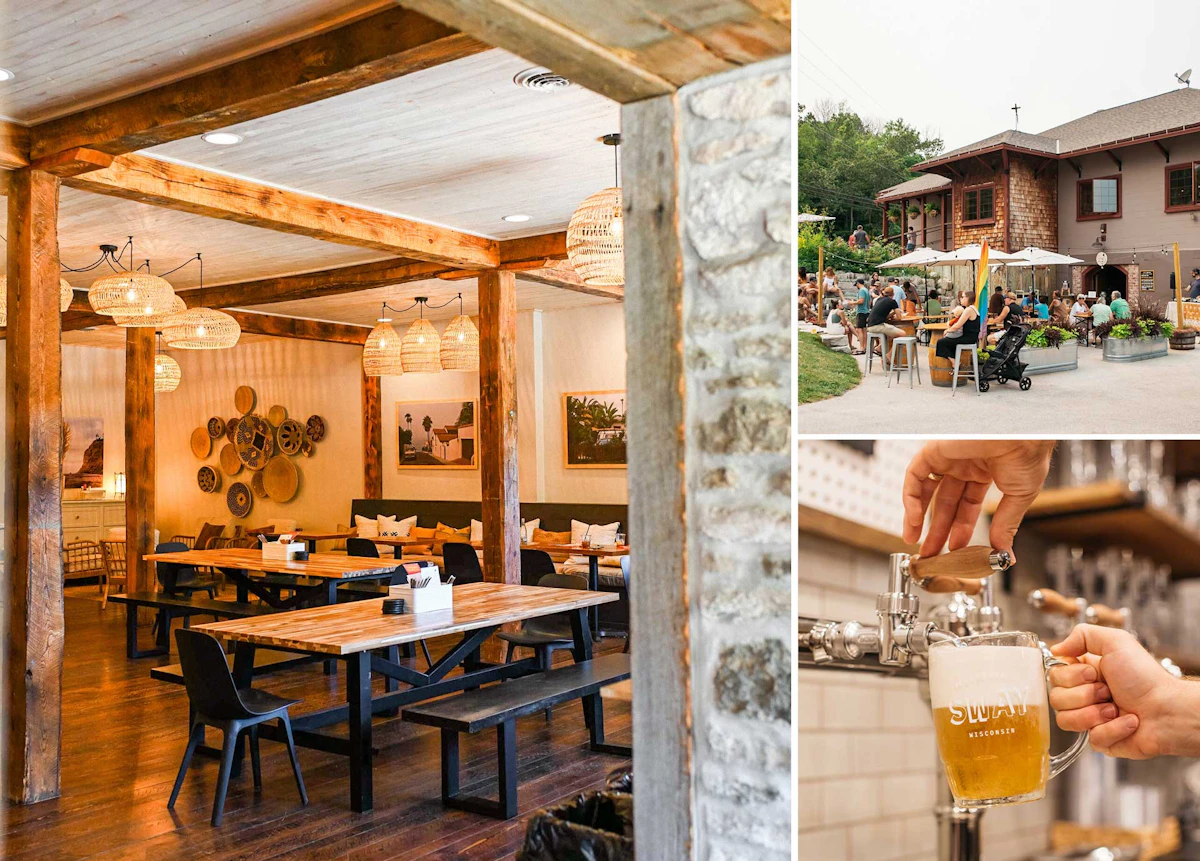
The next turn of fate: That winter, the restaurant upstairs decided to close. Sampson bought the building from the restaurant in March 2023 and converted the upstairs into Sway’s taproom.
These days, he still brews Sway’s batches —seven barrels each, mostly—on Door County Brewing’s 15-barrel brewhouse. He then racks the wort into totes, loads it onto a forklift, and drives it less than a third of a mile down Highway 57 to his own cellar.
Midwestern Flavor
Being the sole owner-operator means that Sampson can make expensive choices that lead to expensive beer—after all, he’s the one who has to sell it.
“For better or worse, I make the choices on all these ingredients that we source,” he says, “and I feel like I have 100 percent say on whatever decision I want to make with the beers.”
Chief among those decisions: If an ingredient isn’t grown in the Midwest, it doesn’t go into a Sway beer. Specifically, all hops are Wisconsin-grown, as are all unmalted grains—the latter specifically from Wisconsin farms that practice regenerative agriculture. The malts all come from Sugar Creek in Lebanon, Indiana. Any additional ingredients, such as fruit or herbs, are locally farmed or foraged in Door County.
“These raw ingredients are representative of specific harvest seasons, the land they were grown on, and the people who grew them,” Sampson says. “We embrace year-to-year variation in our beers and consider them to be an extension of our regional food system.”
He sources the hops through the Wisconsin Hop Exchange, which collects from hop yards across the state. “I’ve found certain varieties I love, like Mt. Hood,” Sampson says. “Wisconsin Mt. Hood has treated me really well.” Others he enjoys using include Super Saazer, Cascade, Centennial, Chinook, and Comet.
Sampson says the character of Wisconsin hops may be comparable to those grown across the big lake. “I used Michigan Chinook a lot when I was at Hacienda, and I think the Wisconsin Chinook has a similar profile,” he says. “It’s much more fruity. And I don’t know if that’s just because of when they pick it or if it’s something about the growing conditions here, but the Chinook is really good. I really like Comet—super red-fruit character.”
Most of Sway’s lagers include that local Mt. Hood. “It just has a very balanced citrus-and-Noble, earthy-plus-spice character to it that is really subtle,” Sampson says. “The varieties are definitely different than what I was used to, brewing with Pacific Northwest stuff at Hacienda.” The Super Saazer, meanwhile, is “definitely more citrusy than a Saaz would be,” he says. “It’s a little bit punchier. I get a lot of lime from it.”
Sway’s top-selling beer, a German-style pilsner called Between You and Me, gets a blend of Mt. Hood and Super Saazer added throughout the boil.
The brewery’s primary base malt, meanwhile, is Sugar Creek Pilsner. “I love the character of his malts,” Sampson says, referring to Sugar Creek founder and head maltster Caleb Michalke. “I don’t know how he does it, but yeah, they’re all very flavorful. They’re not always as consistent as some brewers would probably like them to be, but I don’t really care about that at 200 barrels. But the flavor really comes through, and it’s awesome.”
Sampson says he might use Wisconsin-grown malt except it’s nearly nonexistent; Briess Malt is based in Wisconsin, but virtually all its grain arrives by rail from Wyoming. “I really wanted to focus on [ingredients] grown and processed within a tight radius in the Midwest—and ideally in Wisconsin, if possible.”
Of course, craft malt and Wisconsin hops are going to cost more than Briess malts and Pacific Northwest hops. That difference is built into the beer prices.
Sway’s four-packs cost at least $18 each, “which is expensive,” Sampson says. “It’s expensive for Wisconsin, especially. I think if we were in a populated city, that would be more acceptable. Our draft prices are pretty much $8 across the board. We do get some people every once in a while—especially right when we started—that will verbalize that that’s too expensive. But you know, that’s part of making it work at 200 barrels. You’ve got to price it in order to have a self-sustaining business. And if you don’t, then you won’t have a self-sustaining business. But I think for the most part, that has kind of died. … I don’t think people really mind it now.”
Through Sway’s website, social media, and labels, Sampson works to communicate the brewery’s locally focused ethos to customers. “I think we’ve done a pretty good job of making sure people know where our malt’s coming from,” he says. “I think then they’re okay with paying a little bit more, and they understand, ‘Oh, this isn’t just typical ingredients going into the beers.’”
It helps that the ethos is central to Sway’s identity.
“I don’t know if I would be able to do it if it wasn’t the entire focus of our brewery,” Sampson says. “I feel like it would be very hard to do a one-off beer and get people behind it just because it has different ingredients in it that are more expensive. ... I think it helps when you’re really doubling down on an entire vision, and you know that’s just what people are used to if they’re coming into your spot.”
“An Easygoing Beer Project”
For the brewery’s third anniversary party in July 2025, Sampson created an attractive piece of promotional art: a stylized Venn diagram with three colorful blobs labeled lager, pub ale, and saison—and where they overlap, it just says Sway.
For the party, he released an oak-fermented corn saison, a hefeweizen, and a West Coast–style pale ale, plus Czech- and Mexican-style lagers on gravity casks. Vintage oak-fermented farmhouse ales also were on tap.
None of those party beers were stronger than 5.5 percent ABV.
Generally, Sway’s beers range from 3 to 5.5 percent ABV; only a few mixed-culture beers over the past few years have reached the giddy heights of 6 to 6.5 percent ABV. “It’s not necessarily something I’m going to stick to forever, but that’s kind of where we’ve stuck so far,” Sampson says. “That’s kind of where I like to focus on drinking, and it allows people to enjoy many beverages rather than one or a small pour of something.”
Lagers are driving sales. That German-style pilsner is followed closely by a dark lager, Where the Dark Wind Whirls. Both lagers are year-rounders while the seasonals—including several British-style pub ales such as a dark mild and a session bitter—tend to appear and disappear quickly. Most of the lagers undergo open fermentatin in stainless, while others ferment in a closed oak foeder.
Sampson also has been dabbling in Czech-style lager—though he’s a believer that it should be decocted, and the system at Hacienda is set up only for single-infusion. “I basically brought in multiple propane burners and multiple 10-gallon homebrew kettles, and I scooped mash into those and boiled them. … It was probably an absurd number of little 10-gallon boils, over and over again. … It was terrible. I’ve done it twice. And, yeah, of course, people really like the beer.”
Sampson can-conditions his barrel-fermented saisons for natural carbonation. “And the saisons, they definitely move slower,” he says. “We kind of force them on people and always have them here. We have a ton of people who love them and appreciate that about us, and we’ve found certain ingredients featured in those saisons kind of help sell them or help connect them to a customer who might know they like that ingredient.”
Many of those saisons feature freshly picked fruit grown right there in Door County—including cherries, grapes, peaches, or watermelon—and Sampson says those sell well. Others feature locally foraged ingredients such as yarrow, spruce tips, chanterelle mushrooms, dandelion, or goldenrod.
Those fruited or foraged saisons tend to win new fans among wine drinkers and others who are less interested in beer, Sampson says. “Those I think sell really well just because people are intrigued by them, and they aren’t used to seeing some of those ingredients in beer and at least want to try them,” he says. “And then they actually do taste really good, and then they reorder them or get some cans to go. A lot of nonbeer drinkers also seem to gravitate toward those kinds of foraged saisons. A lot of the flavors in there are not typical beer flavors.”
And while there is some crossover between natural wine and funky saison, beer’s nomenclature has a way of slowing people down. “Whoever came up with ‘natural wine’ is a genius,” Sampson says. “We need a sexier name for mixed-culture saison.”
Beverages, More Broadly
Door County’s seasonal ebb and flow is such that Sampson was able to close Sway this year for two months—February and March—without it being a huge blow to the business.
“It’s a very tourist-driven economy up here,” he says. “Lot of summer influx, fall influx, and then the winter and spring are pretty quiet. … It was always in the plans to do some kind of vacationing in the winter-spring, when it was slower, and build that into our model.”
This year, Sampson and Rawlins spent two of those weeks visiting Belgium—their first time in the country whose beers have inspired many of his. The taproom’s most recent bottle list—a tidy one-pager entitled “Inspirational Beers from Other Places”—is entirely Belgian except for two from Thiriez, in French Flanders. Those bottles include Blaugies Saison d’Epeautre, De Ranke XX Bitter, Senne Taras Boulba, and a few Trappists, plus gueuzes from 3 Fonteinen, Boerenerf, and De Cam.
Then there’s the list of other drinks, which include several natural wines, ciders, hard seltzer, kombucha, and a range of nonalcoholic drinks. All three pages of drinks—Sway’s beers, guest beers, and other beverages—are thoughtful, balanced, and easy to grasp. “That’s kind of the idea,” Sampson says. “Have little bits of things for everyone.”
Altogether, these lists—building on Sway’s own distinctive beers and the ethos that drives them—assemble a lucid picture of why the James Beard committee might have taken notice.
Besides being a tiny brewery, however, there’s another trait that makes Sway distinct from the other semifinalists: The brewery serves no spirits—not even a cocktail. In 2023, Wisconsin passed a law allowing breweries to serve other types of alcohol—before, they could serve only beer. So, Sway could now serve spirits… if Sampson wanted to.
However, “because we’re trying to focus on these lower-alcohol styles and balance, I haven’t really gone down that rabbit hole yet—although I’ve been toying with the idea of some beer cocktails of some sort.”
The Brewer, the Baker, the Spicy-Wonton Maker
Sway’s bakery and kitchen also share that focus on local ingredients.
“The bakery uses 100 percent Wisconsin flour that’s grown and processed here—that same farm we get a lot of these flaked grains and raw grains from,” Sampson says. “And then the kitchen, as well, has dishes that focus on highlighting those interesting Wisconsin grains.”
The bakery started in 2023. Baker Jackie Thelen had worked with Sampson at Door County Brewing, front of house. Later, she baked at the restaurant that sold the building to Sway. “So, we had some history. I was just like, ‘Why don’t you just keep going with your bakery, and we’ll serve it in the mornings?’”
The bakery opens at 7:30 a.m. with a “whole spread of fresh-baked morning pastries,” Sampson says. There are also a few breakfast items, including an egg-cheese sandwich and breakfast burrito, “that we’re hopefully going to expand upon this year as well.” Occasionally, morning visitors will also grab four-packs to go. “We don’t do too much draft-beer sales that early, but sometimes people will get a beer—you know, 9 a.m., especially if you’re up there on vacation.”
The kitchen didn’t take its current form until last year. In 2023, Sampson brought in an outside vendor to run a taco concept out of the taproom “because I did not want to do anything with food.” That ended after high season when the vendor chose to leave the restaurant industry. Then there was a year of Sampson trying to figure out the menu himself, “which went fine, but it wasn’t what I wanted to be doing.”
So, he started trying to recruit Cooper Harwood, the chef at nearby Wickman House—which in 2023 also was a James Beard semifinalist, for Outstanding Restaurant.
Harwood and Sampson had met a few years earlier. “We started talking about weird things that we’re now really doing,” Sampson says. “All the way back when he was [at Wickman House] and I was at Hacienda, he was picking up our spent grain and using it in dishes there and infusing it in weird sauces and everything. He was doing some cool stuff there. … It’s pretty cool that we now have him; he’s really, really creative.”
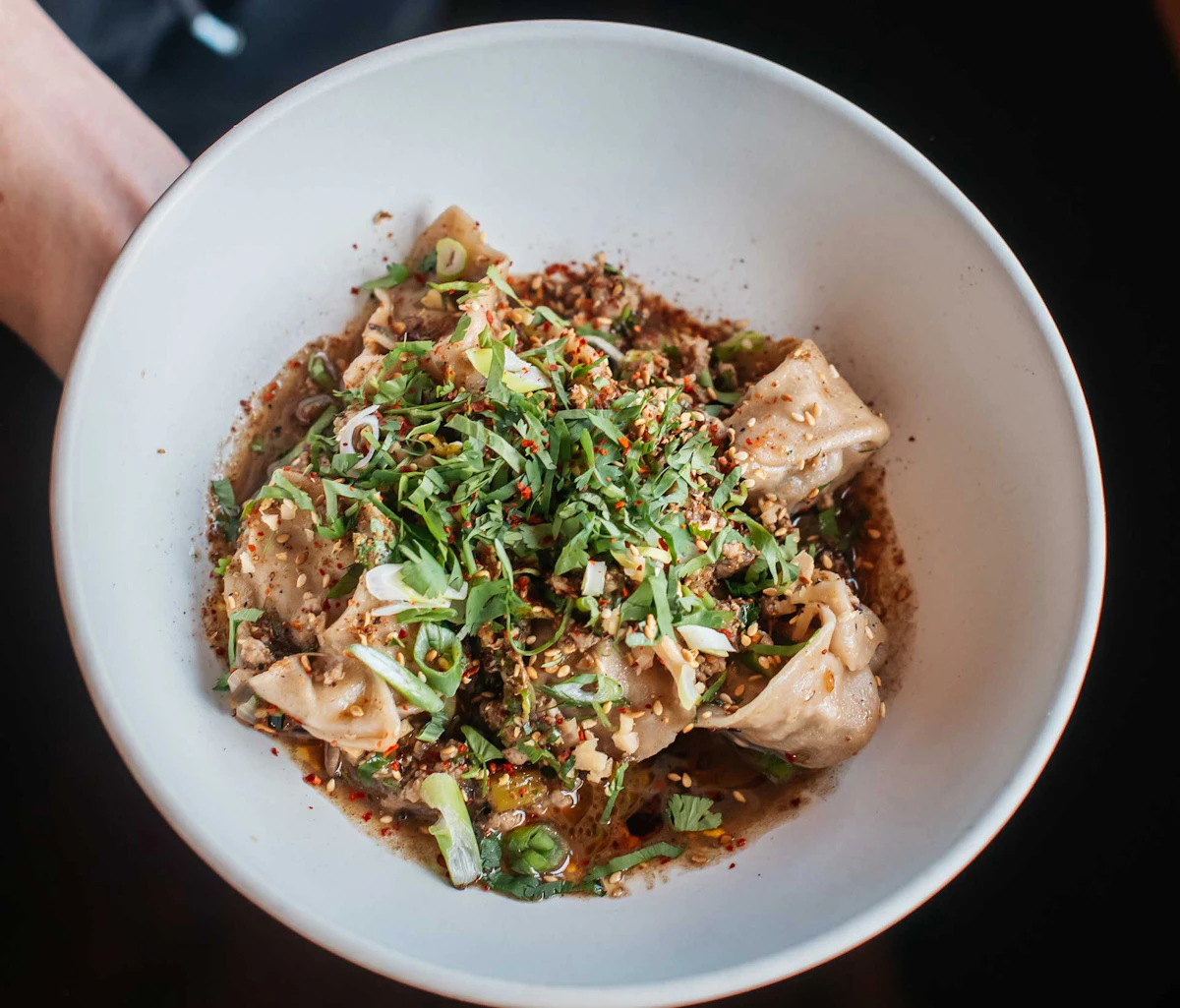
A popular dish at Sway is Cooper’s egg-fried Wisconsin grains—a Midwestern riff on fried rice that includes brown and wild rices plus einkorn, rye, and spelt, with seasonal veggies thrown into the mix. Then there’s the spicy wonton with pork crumble, veggies, mushrooms, and chile crisp. Cooper makes all the dishes with Wisconsin ingredients and with beer compatibility in mind. “It’s a pretty small menu but really packs a punch,” Sampson says.
As with the beer, prices with adequate margins—and customers willing to pay—are what make it work. “I think people knock food, saying restaurants are only making money off the bar or whatever,” Sampson says. “But I think if you do things smart and your margins are good… These other things that I have going—the bakery, the kitchen—they’re all contributing to the overall company. So, all that stuff is helping drive beer sales, and they’re also self-sustaining in a way, as well.”
Modest Ambitions
For now, Sampson is still using the 15-barrel brewhouse down the road. But he’s also starting to plan an expansion that would add space for his own seven-barrel system in Sway’s basement; currently, there’s not enough room.
He’s got four horizontal lager tanks, seven barrels each, that are stackable—except he’s got no room to stack them. In his current space, he might have room for a couple more fermentors that would allow him to brew as many as 300 barrels a year.
Might the Beard-driven publicity lead to a boost in sales this year? “It’ll be interesting to know,” Sampson says. “Because right now, these lagers are the movers. And I’m very strict on the timelines for those in the lager tanks. So, it’ll be interesting if we run out of some lagers this summer. I’ll get a couple more lager tanks ordered, if that’s the case.”
Meanwhile, there are no investors or co-owners telling Sampson to speed up those lagers—every brewing decision is his.
“Which hopefully is the best decision for the beer,” he says, “at least the best decision in my eyes, [even if it’s] not the best decision solely from a financial standpoint. I like keeping it that way so that we can make beer according to what’s best for the beer and also doing customer service the way we want to do customer service—you know, taking time to train people and taking time to really care for the beer, making sure glassware is perfect.
“It helps things stay in line with the vision without getting complicated—not to say that it won’t change over time.”
But if it does change, it’ll be his call.
“For long-term goals, I would like to really just dial in our current location and operations in Baileys Harbor,” he says, “and get everything operating at as high of a level as we can get it—small investments and adjustments over time.”
That might mean making a bit more beer and modestly expanding distribution—perhaps even through a distributor, eventually. Sampson also doesn’t rule out a second location someday, but that’s not his current focus.
“I really just want to operate this small brewery and restaurant,” he says, “and have something that becomes very well known and well respected throughout Door County and beyond.”