

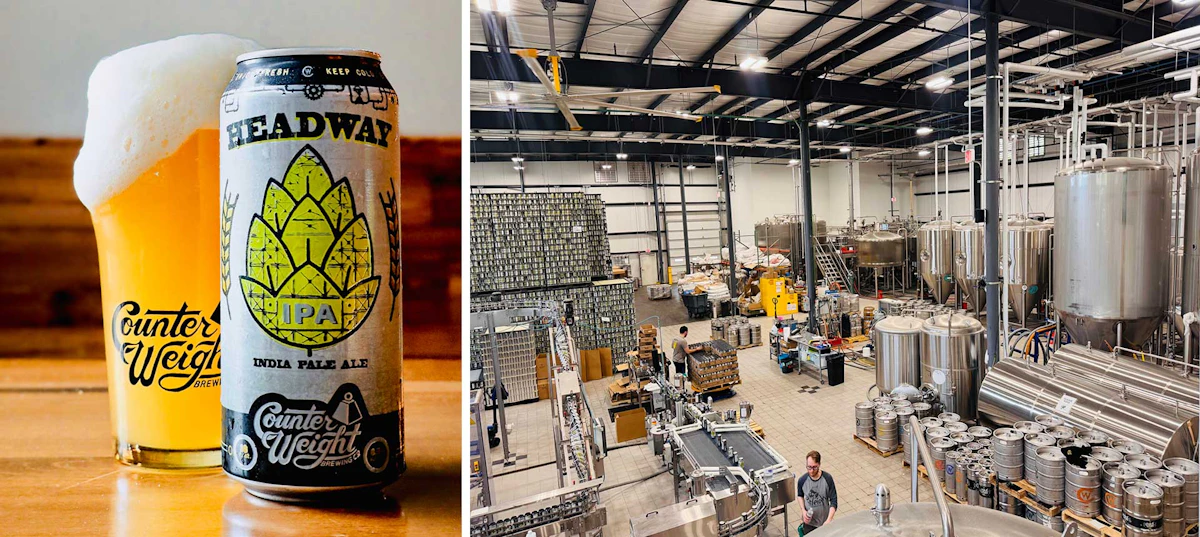
Connecticut’s Counter Weight Brewing sells more ale than anything else—its flagship IPA, Headway, accounts for 60 percent of production. So, the team celebrated an unusual milestone at the most recent World Beer Cup: their first major medal for an ale.
Between the WBC and Great American Beer Festival, Counter Weight has won seven medals in seven years—but the other six were all for lagers. The winning ale at the WBC was Voided, a robust oatmeal stout of 7 percent ABV. The brewery has been making it, and steadily improving it, since the day the brewery opened in 2017.
“We’ve been ultimately working on that beer for close to a decade,” says Matt Westfall, the brewer who cofounded Counter Weight with wife Niki Ellis. “And every year, we sit down as a team, we have a sensory panel, and we make notes on what we like, what we don’t like. And the constant tweaks paid off. We have a group of people that understand what our goal is with that beer, having created this language around that beer for all these years.”
The tweaks are small—adjusting a malt by 1 percent or slightly increasing the finishing gravity—but each one gets them closer to a shared goal.
“This year, to see these conversations and these tweaks and these little, gentle nudges in certain directions result in an accolade was such an awesome thing,” Westfall says. “And for us, internally, medals don’t sell beer. But they inspire our team. They create camaraderie. They have us working in a collective direction, and I think that strengthens what we do collectively to produce beer, whether it’s distributed or it’s little passion projects.”
Medals might or might not sell beer, but Counter Weight is winning them and selling more beer. Based in Cheshire—roughly halfway between New Haven and Hartford, in central Connecticut—the brewery is digging into its footprint. It sells about 95 percent of its beer in state, with the rest going to Massachusetts. And by being as attentive to quality and process details as they are to the accounts that sell their beer, Counter Weight’s team is enjoying steady growth in a challenging market.
“I hate saying this out loud,” Westfall says, as if it might jinx their success or offend fellow brewers who are struggling. “We’ve grown every year we’ve been open.”
However, that growth has been modest and sustainable. Counter Weight sold 16,000 barrels of beer in 2025 and might flirt with 17,000 this year. “Everything we do is through the lens of long-term sustainability,” Westfall says. “I’ve never thought of super-quick, big growth as something that’s sustainable or even manageable.”
Balanced beers, balanced lifestyle, balanced growth—it’s all right there in the brewery’s name and its ethos.
“The idea of Counter Weight itself is this balance between everything that we do as brewers, as producers of a beverage—that balance between hops and malt and fermentation—and personal life, and work life,” Westfall says. “And I think that feeds directly into the idea of the growth of our company. If we grew 6,000 barrels in a single year because we opened 10 markets, is it sustainable? Is that balanced? Are we going to produce that same quality beer that we did the previous year? Honestly, probably not. We know what our ability is.”
“The Worst Salesman on Earth”
When Westfall caught the brewing bug, he was a sociology major at Eastern Connecticut State. He was thinking of becoming a teacher.
ECSU is in Willimantic, a town of fewer than 18,000 people that, nonetheless, had both a brewpub and a homebrew shop. In 2005, Westfall bought his first homebrew kit from Zok’s Homebrewing and Winemaking. He also went to Willimantic Brewing Company and started picking the brain of brewer Dave Wollner. (More than two decades later, incidentally, both the homebrew shop and brewpub are still going.)
Wollner “made fantastic beer and still does,” Westfall says. “And I just really dove headfirst into it. I just fell in love with everything brewing. He was so supportive.”
Soon, Westfall was enrolled in distance courses at the Vermont-based American Brewers Guild, even while working in retail as a beer buyer. He knew he wanted to work in beer, but he wasn’t yet sure how. Once he’d completed the ABG program, the Connecticut-born and -raised Westfall moved across the country to Portland, Oregon.
Why Portland? “Because I just wanted to be around a vibrant beer scene that was much more established than Connecticut’s,” he says. “And after working for a wholesaler out there as a beer salesman, I realized that I was the worst beer salesman on Earth.”
He could homebrew, and he could sell the beers that he liked. “But I couldn’t sell what they wanted me to sell. So, it really made me reimagine what I thought I was going to do moving forward.” Portland, he says, “had plenty of great brewers. They didn’t need me.”
Westfall decided his chances were better back home in Connecticut, where there were still only a handful of craft breweries. That’s how he ended up in Woodbridge, taking on an internship at the New England Brewing Company under founder Rob Leonard.
NEBCO was one of the country’s first craft breweries to package beer in cans—that was in 2003, the year after Colorado’s Oskar Blues made news doing it. When Westfall started at NEBCO in 2007, the brewery was producing about 900 barrels per year. “It was basically myself, Rob—who’s still the owner—and a friend essentially helping out, and some volunteers,” Westfall says. “That was the whole company.”
He loved working there, and after the internship, he wanted to stay. “I made a proposition to Rob that, if I could help grow the company, invest a small amount of money, would I be able to become an owner? Long story short, a year later, I was co-owner, head brewer, salesman, janitor—all the things that you do in a super-small business. And I ended up staying at New England for 10 years, nearly.”
Along the way, Westfall helped to create some of NEBCO’s most popular beers. When he left in 2016, they were producing 13,000 barrels a year. Participating in that growth, he says, “taught me so many hard lessons, and I’ve applied a lot of that experience and that crazy ride to what Counter Weight is, essentially.”
Among those lessons: the importance of basic accounting skills, budgeting, managing raw materials, working with distributors—and getting paid by them. And, more broadly, “really learning how to think about the dollars and cents of brewing.”
Westfall also was NEBCO’s main contact for accounts throughout Connecticut. “Those relationships developed and grew,” he says. He realized that because he was communicative and appreciate—“having come from that retailer side, knowing what I wanted to see out of a salesperson”—that they responded positively. “I never thought of them as needing it. It was the fact they chose to support us.”
That rapport and those relationships helped at NEBCO. Naturally, they also helped as he and Ellis got Counter Weight up on its own two feet. “They knew that I was going to follow through with my commitments, and some of these people have chosen to support this brand based on those early experiences way back, almost 20 years ago at this point.”
Westfall, as it turned out, was no longer the worst beer salesman on Earth.
“It was much easier when you were selling something that you were trying to create and working so hard on,” he says. “You were able to talk a little bit about the why, the what, the how—everything you put into it.”
Westfall says he loved his time at NEBCO but, then in his mid-30s, was ready to make the leap and start his own business. “I had this itch I needed to scratch.” His thought process: “If I ever wanted to do something that was for myself or my family, with my wife, now’s the time. I really shouldn’t wait any longer.”
Package, Distribute, Host
He believed there would be opportunity for something different in Connecticut. He and Ellis sat down to come up with a plan for a distribution-focused brewery with a taproom.
Today, Counter Weight sells a bit more than 10 percent of its beer through its taproom, but that accounts for about 25 percent of revenue. The bulk of the business is packaged, distributed beer.
The distribution focus was important to Westfall. Hospitality is in the brewery’s DNA, but the cornerstone is “affordable, high-quality, accessible beer on the shelf for everyone,” he says. “So many of our favorite breweries are smaller, boutique-y, very particular. I love some of the beers they produce. But I also love the fact that in this day and age, I can walk into a grocery store or most of the retailers and pick up something reliable, dependable, and affordable. And we wanted to be a part of that concept.”
For Counter Weight’s first full year in production—at the first location in Hamden, about 12 miles south of Cheshire—Westfall and Ellis estimated that they would sell about 1,500 barrels of beer. They doubled that and have grown steadily ever since, moving to the larger Cheshire brewery and beer hall in 2022.
The new facility gave them space to grow production, but it also gave them space to host more customers—including private events, which have been a welcome source of revenue. (On the evening Westfall and I spoke, Counter Weight had just hosted a corporate event in the upstairs taproom plus a wedding in the atrium.)
Embracing events wasn’t always a sure thing—Westfall and Ellis bought the Cheshire property just before the COVID-19 pandemic hit and lockdowns changed the world. The team held a meeting to discuss how to move forward with the expansion.
“Ultimately, at the end of the day, people are people,” Westfall says. “They want to be social. They want to interact with each other. … And I’ve got to give my wife a ton of credit. I was honestly kind of like, ‘I don’t know what to do.’ And she really pushed us forward—and I’m glad she did because as scary as that time was, I can’t imagine not being here now and being a part of this community in Cheshire.”
Westfall says Ellis, the company’s general manager, is a dynamo for Counter Weight. “She does everything. I mean, when we first started, she ran the canning line. She has worked in the taproom. She’s done literally every job here.”
The Brewery’s Other Workhorse
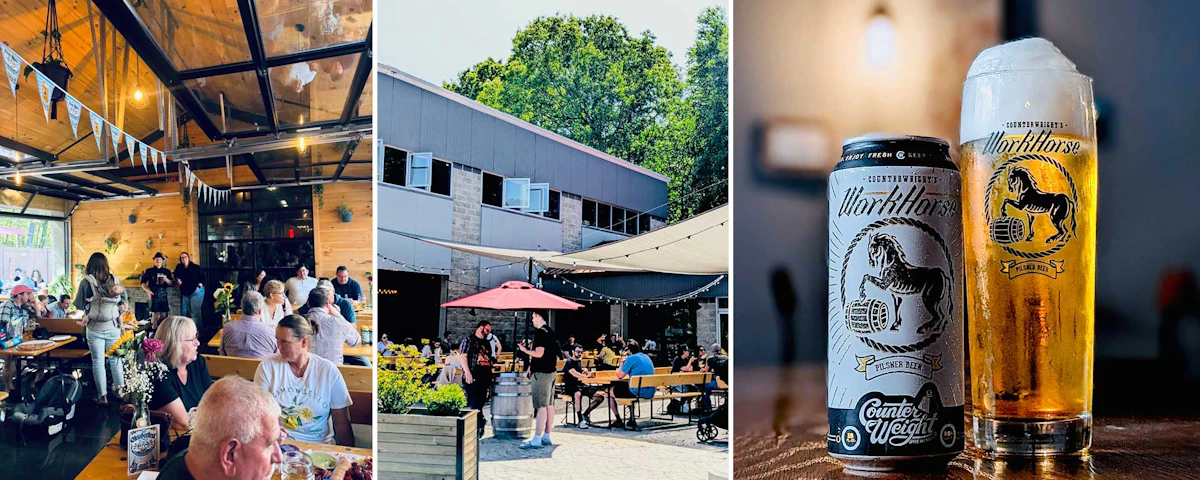
The brewery’s top seller, Headway, is a juicy but bitterish New England IPA of 6.5 percent ABV. But the No. 2 beer—and currently the fastest growing—is the Workhorse Pilsner.
Workhorse—which won silver for German-Style Pilsner at the 2023 World Beer Cup—is unfiltered, 5 percent ABV, made of IREKS pilsner, fermented by the Augustiner strain, and packed with floral Tettnanger hops.
“If I’m being very honest, Workhorse Pilsner is just… it’s my favorite beer,” Westfall says. “It’s not my favorite Counter Weight beer. It’s my favorite beer.”
Being super-dialed in to it, however, also means that he doesn’t automatically love every batch.
“There’s always something that I notice that maybe our guests or even some of our team don’t notice.” Those subtle differences, he says, lead to a “neurotic kind of panic” that leads to slight tweaks and corrections. “That’s not always the most pleasant feeling. I think it keeps our beers in line—not only for that beer, but for all of our beers because I could say the same about a lot of things we produce.”
Then there are the good days.
“When that beer is falling [within] those guardrails that we’ve mentally created for ourselves, our team is just happy. I love at the end of the day on a Thursday or Friday, our hot-side or cellar team is sitting down to go over the following week, and everybody’s drinking a Workhorse, and it’s just smiles. There’s lacing on the glass. The beer looks so bright and clear. I can smell floral Tettnang hops around that table, and it’s just like, ‘Oh, we’re doing all right.’ And I’m motivated for this next week. I’m pumped, no matter what we’re brewing. What we produce that we’re all consuming right now is what it’s all about. That’s what Workhorse is to us.”
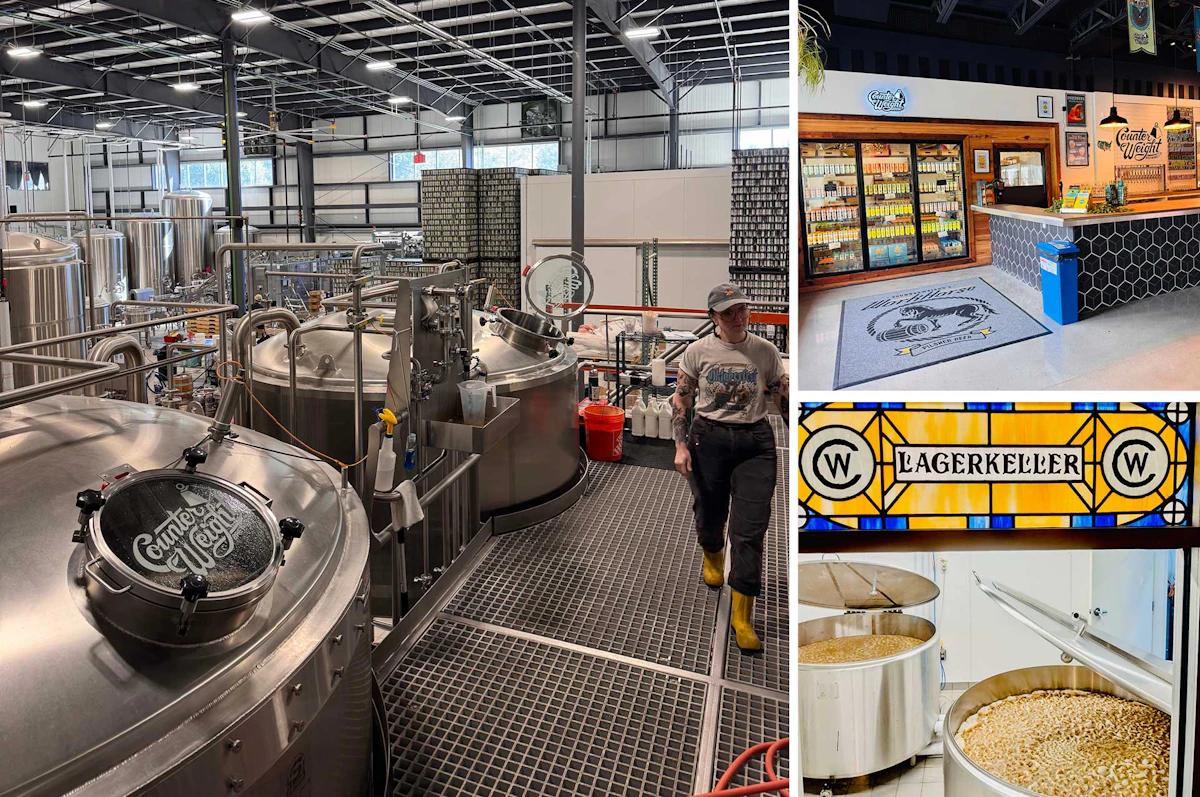
The move to the bigger brewery in Cheshire wasn’t only about capacity. It was also about adding flexibility to tinker with lagers. Counter Weight won its first major medal in 2020—a gold at GABF for its seasonal Fest Bier. (Find the recipe at beerandbrewing.com.) That beer, however, got a single-infusion mash. The newer brewery includes a four-vessel, 30-barrel Sprinkman system plus a 10-hecto (eight-barrel), four-vessel Kaspar Schulz “pilot” system. Both can handle step mashes and decoctions. The brewery also added two open-top fermentors.
The smaller Kaspar Schulz system also allows them to produce more variety for the taproom.
“That was one of the things we learned in Hamden,” Westfall says. “Using the single brewhouse to feed both distribution and the taproom became a pretty big challenge.” Once their flagships took off, it became increasingly difficult to make room for the passion projects and the kinds of beers that can bring people in the door. “We don’t want to be limited by tying that brewhouse up with our flagship beers. We want to have the ability to run them both in tandem and feed the beer hall as well as our distribution network.”
It took months of dialing it in, but Westfall says they get good repeatability between the Sprinkman and Kaspar Schulz systems. “That was a little bit of a learning curve,” he says. “We started to draw some of those parallels of what made sense on paper and sensory-wise over time. But I think that within six to eight months, we were pretty happy with what we had learned.”
Westfall credits his production team for being able to pull that off.
“We have a seasoned group of people here,” he says. “Most of our staff has been with us six, seven, eight, nine years at this point. And having this whole team stay together has been such a fundamental, important thing, as far as how we’ve been able to be efficient and successful and develop a language together, so that we all have a singular, focused, achievable goal.
“We don’t always agree, but at the end of the day, we’re all striving for the same thing.”
The Drive for Authentic Flavor
Westfall, often with Ellis or members of the production team, travel to Germany once or twice a year. The beers they’ve had there have been hugely influential on Counter Weight’s lager program—especially on Workhorse, whose inspirations include Keesmann Herren Pils and Schönramer Pils.
Westfall credits much of Counter Weight’s lager success to those trips, where they’ll soak up as much information as they can while talking to brewers, hop growers, and other contacts.
“Essentially, we have all these questions,” Westfall says. “Why do these beers taste the way they do? Can we reproduce them, and do these methods ultimately equal the flavor profiles or aromas that we’re experiencing? The only way that we can figure that out is by trying it.”
Over the past few years, the team has been able to track the results, “as we repeat these processes and then tweak and make them fall in line with what our goals are, as far as flavor profiles.” They can translate the theoretical, he says, to “tangible goals within what ends up in the glass.”
Workhorse gets a step-mash aimed at attenuation and a dry profile., “so that the nice, pleasantly bitter kind of sharpness comes through, and it makes you just want that next sip. And the goal for that beer is just to be big and floral. All the beers that I’ve had, traveling—that our team has had, visiting a bunch of breweries—the pilsners that we all love are kind of aggressive, right? I can remember so many beers that I’ve grabbed from a kiosk at a train station, and I’m drinking the beer out of a bottle, and I’m like, ‘Why is this so bitter? This is wonderful.’”
A visit to Schönramer a few years ago convinced Westfall to pay more attention to the Tettnanger they were getting. Brewmaster Eric Toft was there, “giving me more information than I could ever possibly imagine, and I probably processed 15 percent of it, honestly,” Westfall says.
Toft also had just been doing hop selection in Tettnang. “He had all these samples on the table, and I got to rub the Tettnang that he had selected, and I was like, ‘I don’t think I understand what this hop is.’ It was just so big and bright.”
They also like what they get from BSI’s Augustiner strain. “It’s not quite as ‘clean’ as 34/70,” Westfall says. “It kind of accentuates some of the things in the beer a little bit more. Sometimes, depending on temp, it’s a little bit more sulfury, which we like. I think that also adds to the drinkability of the beer. And after that, packaging it well, so that if you grab a four-pack, or you’re having it in a restaurant …, it’s just a big, nice, tight-foam-capped beer that just hits all those notes.”
Part of their goal with the lagers, Westfall says, is to transmit the experience of great, fresh German beer to the people of Connecticut. They are proud to say, “Hey, this is a pretty authentic example of this because we’ve done the research.”
“My wife makes fun of me all the time and says, ‘How do you remember this weird flavor profile?’ But I’m sure you’re like this: People who think about beer just do. Little things stick in your head, and you start chasing them. Does this Munich malt taste like this? Does this base malt taste like this? Do these hops that I’m sourcing reflect some of the things that I loved about this other beer I tasted?
“How do I achieve that here and share it with people, so that they can get the level of joy that I got out of having some of these things. That’s really our overall driver: When we say, ‘This is a German-inspired beer,’ hopefully it’s as authentic as it possibly can be, being produced very far away from that place.”
Accessible and Available
As Counter Weight digs deeper into Connecticut, Westfall emphasizes the importance of showing appreciation to all the shops, bars, and restaurants that sell and pour their beers.
“Ultimately, we really like the idea of driving to nearly every account within a [day’s drive] that chooses to serve our beer, so that we can support them,” he says. “We want to be available. We want to service these accounts, and we realize that whether we’re brewers, we’re salespeople, or we’re in the front-of-house, everybody that works for Counter Weight is in hospitality. And we want to make sure that our guests and our customers realize that we appreciate what they do for us, that they choose to support us, and that we understand they don’t need to support us.”
Westfall still sometimes gets out to accounts himself, even if it’s not as often as he’d like. “I am happy to give my phone number to everybody,” he says. “I get texts all the time just asking questions about what we’re up to, what’s available, what’s going on. And I think they feel like we care because I give them accessibility.”
He’s aware that many other owner-brewers might prefer to be insulated from that level of communication. “I get it,” he says, “but I want people to realize that we understand that at the end of the day, they don’t need us. They choose to pour us. There’s always another brand behind us that can take that line, that can take that shelf space. And it’s one of the reasons why we price [our] beer the way we do, and it’s another reason why we make ourselves accessible.”
Westfall praises their sales team, including experienced sales manager Larry Golia, who’s seen some ups and down in the industry. There are many lessons to learn—and they can sound complicated, Westfall says—but they boil down to: “How are you servicing your accounts? How do you make them feel appreciated? What are they getting out of this deal? What are they making on the keg or the four-pack that you’re selling them? And is it accessible? Is it in stock regularly? Is it of quality? … I don’t mean to dumb it down, but it’s hitting those main things.”
Anyone spending money on Counter Weight’s beers—especially if it’s part of their own business—wants to be seen and heard.
“And I don’t blame them,” Westfall says. “You know, I feel that way with our hop brokers, our growers, our malt suppliers, our PakTech and can suppliers. So why wouldn’t our bars, restaurants, and retailers feel the same exact way?”
Balance in All Things
The guest who arrives at Counter Weight’s brewery can choose from multiple spaces to inhabit and, ideally, relax.
There’s the patio with its German-style beer-garden tables, plus cornhole and a bocce court. From there you can walk into what they call the “atrium”—in nice weather, its eight glass garage doors open onto the patio. Or you can head upstairs to another space with a bar that overlooks the brewery.
“We wanted to build a space for our community,” Westfall says. “Having traveled and visited other breweries that have inspired us, whether it’s in the United States or elsewhere, I loved the places that were able to draw in their community—not just solely around the beer they were brewing, but also as a third space for all kinds of people to meet together. We really drew inspiration from that.”
The space and special events also help to bring in new customers. There are still first-time guests who live within 20 miles of the brewery who didn’t know it was there until they came for a wedding or a vinyl-record show. (The latter is one of the brewery’s biggest days of the year.) There’s a synergy between the focus on getting high-quality, accessible beer out to market and a recognition that the brewery is in the business of hospitality.
There’s also a balance there, and that approach extends to various facets of the company, whether it’s keeping bars happy, brewing delicate lagers or highly hopped IPAs, fine-tuning a gold-medal stout—or managing the team’s own quality of life.
“I feel like everything we discuss as a team always comes back to balance,” Westfall says. “Coming from a background where I was working 80 or 90 hours a week and kind of killing myself as a young person, I didn’t want our team to do that. I didn’t want to do that anymore, and we wanted to create some balance between professional and personal life.”
Whether it’s a rough beer market, a rough economy, or a generally rough state of the world—or maybe you just had a rough day—that intention also extends to their customers.
“The idea of what we do at Counter Weight is, ‘Can what we put in your glass be the counterweight to your not-so-great day? Can it balance out what you experienced this week? And if we can kind of balance things out for you—because you were able to sit down and talk to somebody and enjoy something we produced—then we feel that we’ve achieved our goal as Counter Weight.”