

It’s been only a decade since Steve Parker started homebrewing. A few years later, fans were waiting in lines every weekend for cans at Fidens of Albany, New York, and it quickly earned a name among the country’s top brewers of hazy IPA.
Yet the industry shifts, the market changes, and even haze-bros and -sisters get older. Fidens has matured right along with them, these days offering a popular taproom with full kitchen, welcoming locals whose beery comfort zone may be more in the realm of Mich Ultra or Yuengling.
“I love it when we turn non-IPA drinkers into IPA drinkers,” Parker says. “That’s my favorite thing.”
Parker and fellow cofounder Tim Pierce opened Fidens in late 2019, and for a long while almost every beer they made was hazy IPA. When they opened the 11,000-square-foot taproom in July 2023 in Albany’s Warehouse District, it was a boost for the brewery and an evolution of the business.
Although many haze enthusiasts around the world have heard of Fidens, the brewery doesn’t distribute its beer—it sells virtually all of it through its taproom. And serving the locals throughout the week is a different sort of game.
“People know our beer all over the place,” says Parker, now a CEO who is still closely involved with production. “Yet we’ll go to a local beer festival, and someone’s like, ‘Oh, I live 10 minutes down the road. Who are you?’ So, it’s trying to capture that audience.”
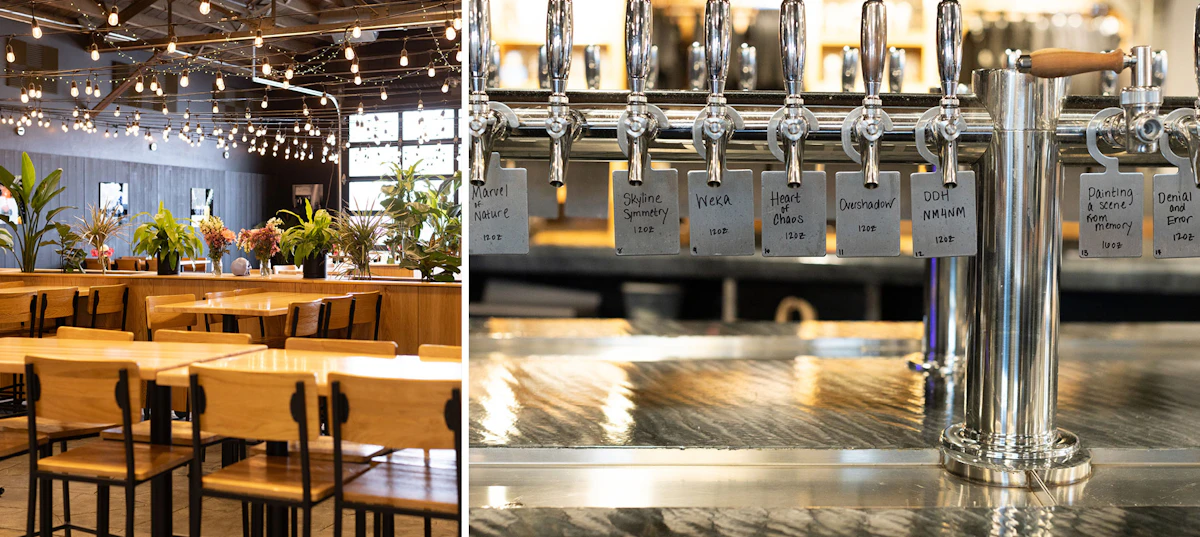
Full Service
Besides 30 taps, the Fidens taproom has a chef-run kitchen sending out plates of popular pub grub—burgers, tacos, wings, poutine, Sunday brunch, and more.
“We’ve seen that food is a really good marketing tool to get people into Fidens that normally, probably, wouldn’t come in,” Parker says. “And it’s great because these people come in, and they’ve never had our beer, and we interact with them, and you see them walk out with four to six cans. And you’re like, ‘Yes, that’s awesome.’ That’s the goal, and they come back every week.”
Specials throughout the week—like $20 for a burger, fries, and a pint on Mondays—help to attract local families. The kids’ menu is important, too—$8 for a junior smashburger, grilled cheese, or hot dog, plus fries—because it brings in families who wouldn’t come otherwise. They also keep the menu from getting stale.
“We rotate the menu quarterly to keep it fresh and keep people excited about it,” Parker says. “We like to treat the food like beer—you know, have your core items and then keep putting out fresh new twists.”
And while there’s plenty of overlap, the locals who come for the taproom and its food aren’t the same crowd who once lined up on weekends—and even the hardcore fans are in different places in their lives now.
“It’s a different road once you open that taproom,” Parker says. “People still come get cans, but now people want a full experience. They want to come in, have a draft, have food; they want a place where families can hang. We have arcade games and board games where the kids can play. We figured out, all the beer guys who stood in line seven-plus years ago now have kids and families and stuff. So, we had to make it more family friendly.”
Broadening that appeal also has meant broadening the range of beers—tackling lagers, stout, and West Coast–style IPAs, for example—and that’s a challenge that Parker and his production team have enjoyed. About 60 percent of the brewery’s business is canned beer for takeaway, and more than 90 percent of those cans are full of double or triple hazy IPA. But the rest of the business is in the taproom.
“Obviously, we’re still super hop-focused, hazy IPA–focused,” Parker says. “But having people that are non-hopheads all the time come in, we’ve had to [brew] way more lagers and classic styles. And we’ve really ventured out to have something for everybody.”
Besides a beverage program that ranges from New York state spirits and wines to house-made, barrel-aged seltzers, it’s critical to offer beers that dip into the lower ABV range. People tend to drink lighter stuff while there, then buy some cans of higher-octane haze to take home and enjoy on the couch or back deck.
On draft at the taproom, Parker says, the top three sellers tend to be a lager, a hazy pale or single-strength IPA, and a tart fruit beer—and after those, maybe, a double IPA. In particular, he says, a Mexican-style lager of 4.5 percent ABV lately has been a hit.
“For us, there’s been such a shift [toward] the low-alcohol—that’s what people really want at the taproom,” he says. “They want low-alcohol and then cans to-go. Triple and double IPAs are the kings of cans to-go.”
Albany, he says, is more of a drink-at-home city than a bar-crawl town; it’s not very walkable. “People like to sit at home in front of a fire, or sit on their deck, sit outside and drink beer. ... People come, they go home, and they chill at home or chill at a friend’s house.”
Keeping It Fresh
Fidens launched with a four-barrel brewhouse and upgraded to a seven-barrel Stout system in 2021.
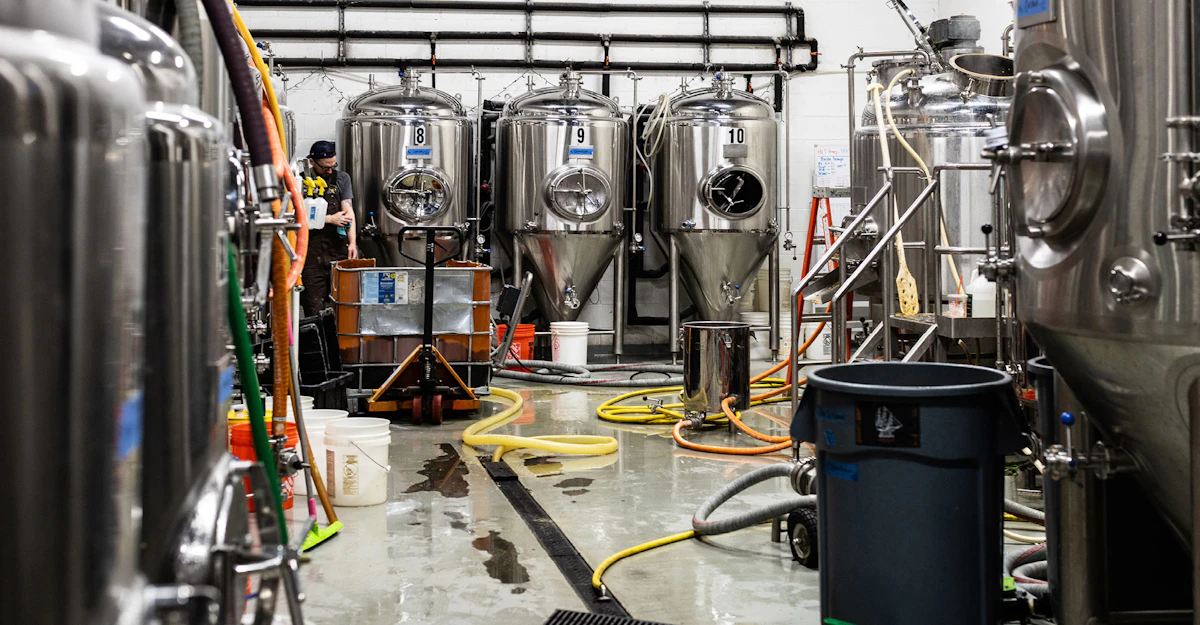
Five years later, Parker and team—including head brewer and co-owner Anthony Dana—are still brewing on that same seven-barrel system, but they keep adding tanks. There are now about 25 FVs, as they brew three turns a day, five days a week. The brewery expects to brew about 5,000 barrels in 2026.
They previously had 30-barrel tanks at their production facility, but they recently swapped them out to rely solely on 15-barrel tanks.
“Same amount of barrelage, just smaller batches, and it was a complete game changer,” Parker says. “You know, 30 barrels is a lot of beer. ... We have a goal at Fidens that we want every beer to be gone two weeks from packaging date. That is our goal, and we weren’t hitting that with some of the 30-barrel batches.”
Now that the batches are smaller, they’ll often run out of a particular beer in less than a week. “We’ll drop about nine to 10 beers a week, and there might be one or two that carry over to the next week, and they’re usually gone by Monday or Tuesday.”
When you’re releasing that many beers a week, and when most of them are double or triple IPAs, keeping them distinctive can be a challenge. Mixing up hop varieties and using different combinations is obviously critical to that effort. But Fidens goes further, getting as granular as featuring different hop farms and pick times.
For example: Fidens Orchid is an all-Nelson double hazy of 8 percent ABV—but Nelson hops can express in many different ways, depending on the lot and the pick time. So, the brewery might feature Nelson only from Eggers or Freestyle or Garston hops. “Or, we’ll do early-pick Nelson, which is very different than late-pick Nelson,” Parker says. “So, it’s just giving the customer a different experience and educating them a little bit.”
Developing direct relationships with those hop farmers is key to producing that kind of variety.
“We’ve been really working with farmers a lot,” Parker says. “The hop farmers have been great, and we’re getting experimental hops to try out in these beers. ... I’m really excited [about] how the farmers and the brewers, the brewing community, seem to be really working together right now. And they’re listening to us, and they’re producing stuff that we want.”
Even embracing those technical differences, it can be a challenge to come up with something fresh—whether it’s a name, a new hop combo, or a new angle.
“I write all of our recipes and all the labels and the names,” Parker says, “so, sometimes I just stare at that computer like, ‘What...?’ But then it just hits you, and that’s it.”
For the Fidens team, it’s worth the effort to keep those batches small and facilitate the variety that their customers want. If the brewery expands—they’re currently looking at a larger location, but the deal isn’t final—Parker says he wants to stick with those 15-barrel tanks, allowing them to move new beers quickly and keep them fresh.
“If Jasper sells out in eight days, we can make it again; it’ll be out in another 14,” Parker says. “That’s just the model that we have, and Tim and I have always stuck to that. Sometimes more beer is not better. I think you’ve just got to be smart about it.”
Cans Are Still King
The long lines are gone, for the most part. Online ordering with a few days grace to pick up the beers has made for a smoother retail experience.
“Is it cool to see 100 people lined up for your beer? Absolutely,” Parker says. “But times change. I couldn’t do that right now, and I used to be one of those guys who would line up at Trillium and Tree House and Bissell Brothers and Hill Farmstead. … So now, the goal that Tim and I talk about quite a bit is, how do we get the beer in people’s hands the easiest way possible?”
Fidens sells all its cans as singles, typically around $6 a pop. An experiment with selling four-packs instead of singles didn’t stick.
“At first, people were not happy,” Parker says. “But everybody was doing four-packs, so we’re like, well, we should try four-packs. And what we noticed is the popular SKUs or the new SKUs would fly, and the older SKUs would hang around. And when we were making people commit to four beers, they were much more selective: ‘This is what I want, and that’s it.’”
That didn’t work for the Fidens model of constantly churning out fresh variety.
“A lot of times, people don’t want a four-pack,” Parker says. “When you’re releasing nine to 10 beers every week, they want to try one of everything. So, that’s what you’ll see—you’ll see one can of this, one can of that, or two of this, two of that. And now we’ve noticed [that] all the SKUs move. The popular ones, the newer ones, do go quicker. But West Coast IPA, when we were in four-pack, would sit there forever. Now we’re selling them out in probably 10 days.” (It’s worth noting that a recent batch of triple West Coast–style IPA sold out in only four days.)
The option to buy singles is ideal for those who aren’t sure whether they’re going to like a beer. It’s also more budget-friendly because those single cans come at a lower price point.
“They come in and they get whatever they want to try, and then they come back next week, and they get whatever they want to try,” Parker says. “If somebody’s only got 10 bucks, well, they can walk out of here with two beers. If [we only] had four-packs, they couldn’t walk out with anything. This goes back to, what’s the easiest way we can get this product into people’s hands? And the single cans, it might not work for everybody, but it works for us.”
The lines aren’t entirely a thing of the past. Many customers pick up their pre-ordered cans on Fridays, and that’s also when the brewery releases crowlers of fruited beers or other experimental one-offs. They might fill 250 to 300 crowlers, “and they’ll sometimes be gone in like 30 minutes,” Parker says. “It’s great.”